
Author: Dr. Martin Josef Maxl

  • Maxl & Mötz supports the Doderer Symposium 2026 at the Wien Museum

    Maxl & Mötz supports the Doderer Symposium 2026 at the Wien Museum

    Together with PORR AG and Julius Meinl Austria GmbH, our firm is supporting the rediscovery of one of the most linguistically powerful Austrian authors of the 20th century.

    Maxl & Mötz Rechtsanwälte is among the sponsors of the symposium „Doderer’s Vienna: An Author and His City“, which will take place on 19 September 2026 at the Wien Museum on Karlsplatz. We are delighted to share this commitment with two further renowned partners: PORR AG and Julius Meinl Austria GmbH. As sponsors from the very outset, the three companies – together with Stadt Wien Kultur, the Federal Ministry of Housing, Arts, Culture, Media and Sport, and the Wien Museum – are making possible a full-day event of high literary-scholarly quality, free of charge for the public.

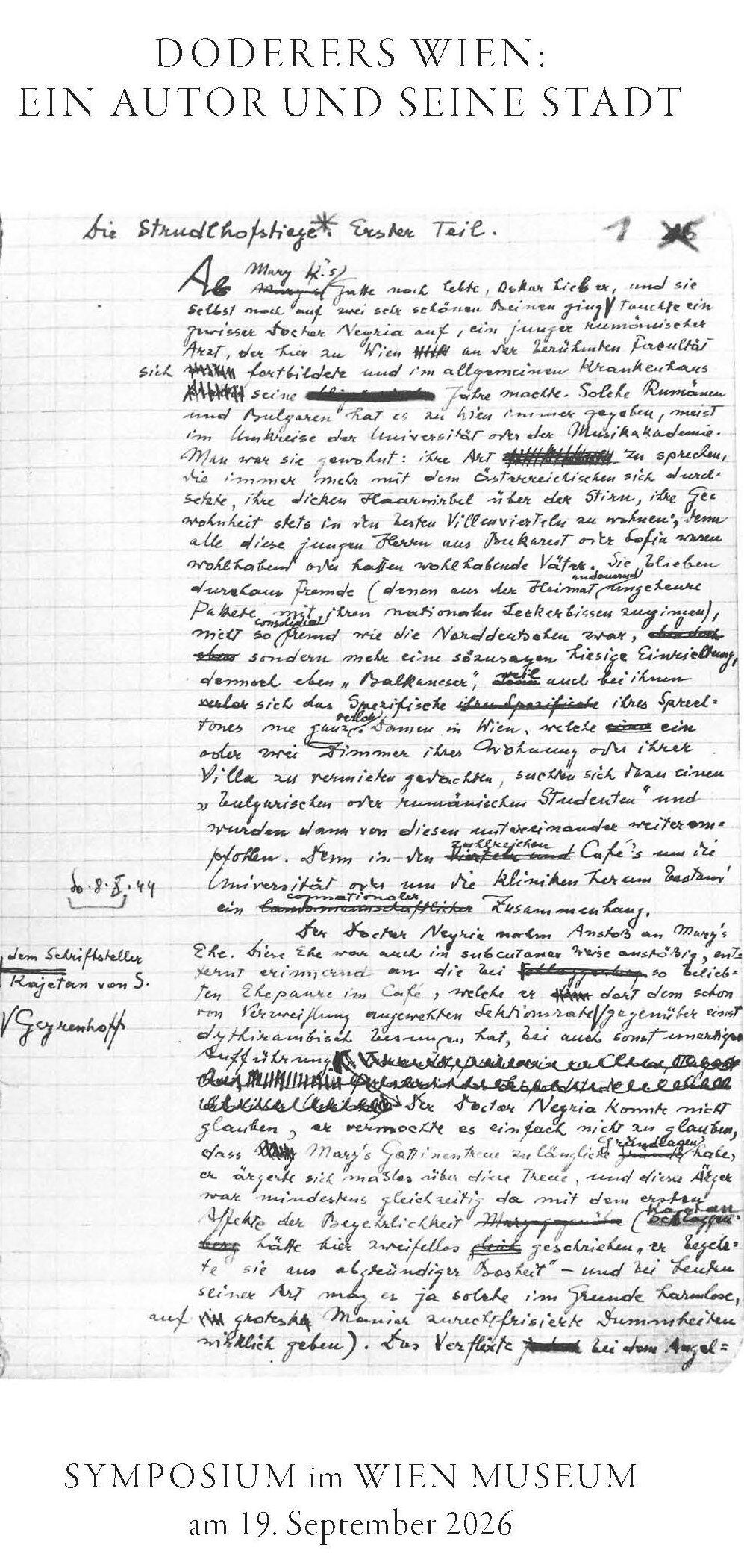
    The occasion is the 130th anniversary of Heimito von Doderer’s birth and the 60th anniversary of his death. „Now I am coming!“ Thomas Bernhard is said to have exclaimed after Doderer’s death in 1966 – „Now Doderer is coming, once again!“ is the unofficial title of the symposium. With The Strudlhof Steps, The Demons and The Waterfalls of Slunj, Doderer wrote three metropolitan novels in which Vienna is not merely a setting but a poetic resonating space. The event is not intended as a nostalgic retrospective, but as an invitation to rediscover an Austrian author of world stature.

    The organiser is the Wiener Heimito von Doderer-Gesellschaft, founded at the end of 2024 and based c/o Maxl & Mötz Rechtsanwälte GmbH. Dr. Martin Maxl, partner of our firm, is a founding member of the society as well as the initiator and organiser of the symposium; he will open the event and contribute a lecture of his own on Doderer’s Viennese novels.


  • Register of Beneficial Owners – changes from 1 July 2024

    Register of Beneficial Owners – changes from 1 July 2024

    In its capacity as the register authority, the Federal Ministry of Finance has provided information about the changes to the reporting of beneficial owners under the WiEReG in its Technical News 2024/02. These changes, which are based on the WiEReG Amendment 2023 (BGBL I 2023/97), enter into force on 1 July and concern reports transmitted to the register after 30 June 2024.

    All reports submitted after this cut-off date must take the changes into account. A renewed submission of a report before the annual review falls due (§ 3(3) WiEReG) is not required. The updated WiEReG BMF decree is expected to be published in August; the BMF’s collection of case examples will be adapted to the new legal situation and published on the BMF’s website. For matters affected by the changes, the new reporting forms must be used from 1 July 2024, irrespective of whether the due diligence obligation under § 3 WiEReG is performed before or only after this cut-off date.

    The most important changes that must be reflected using the new reporting forms are:

    • disclosure of relevant trust relationships within the chain of ownership;
    • the possibility of waiving the automatic transfer of data for domestic foundations and trusts as top-level legal entities;
    • reporting of trust relationships in the case of foundations, trusts and comparable legal entities;
    • statement of the proportion of assets contributed in the case of foundations, trusts and comparable legal entities;
    • reporting of the insolvency administrator as subsidiary beneficial owner where no top management level exists.

    The new reporting form for party representatives has already been available since 1 July 2024, in parallel operation in addition to the existing forms. It has been developed from the ground up.

  • On the bad-faith application for trade marks (specifically the „Lippizaner“ marks)

    On the bad-faith application for trade marks (specifically the „Lippizaner“ marks)

    Bad faith is to be assumed in particular where the applicant, without any specific business relationship with potential users, applies for a multitude of marks with little or no distinctive character, only a small proportion of these applications actually leads to registration, and no realistic business model is discernible for any use of these marks going beyond the assertion of injunctive and payment claims (OGH 27 June 2023, 4 Ob 54/23d).

    Under § 34 MarkSchG, anyone may seek the cancellation of a mark if the applicant was acting in bad faith at the time of the application. The concept of „bad faith“ is a concept of EU law that must be interpreted uniformly. Whether an application was made in bad faith is, according to the case law of the ECJ, to be assessed „comprehensively“, taking into account all „relevant factors“ in the specific case. Bad faith has hitherto been affirmed primarily in the case of a breach of loyalty obligations or in the case of the obstruction of a third party already using the sign. However, it cannot be inferred from the case law that bad faith is limited to these categories of case.

    A bad-faith acquisition of trade mark rights within the meaning of § 34 MarkSchG presupposes the applicant’s intention, by registering as a trade mark a sign already used by a third party, to obtain a weapon in order to disrupt a system built up by a competitor. This intention need not be the applicant’s only motive; it is sufficient that it is an essential motive. A trade mark application is also made in bad faith where it is made without any intention of the applicant’s own use or marketing, but serves principally to pursue third-party undertakings that later use identical or similar signs for injunctive relief and payment. This is to be assumed in particular where the applicant, without any specific business relationship with potential users, applies for a multitude of marks with little or no distinctive character, only a small proportion of these applications actually leads to registration, and no realistic business model is discernible for a use of these marks going beyond the assertion of injunctive and payment claims. Bad faith is to be assumed where, at the time of the application, the trade mark proprietor was aware that competitors were using, for similar or identical goods, signs that are confusingly similar to the sign applied for by him as a trade mark. The only point in time relevant for the assessment is the time of the application. Later conduct of the applicant or trade mark proprietor contrary to public policy can no longer be pursued under this provision.

  • Misleading top-position advertising

    Misleading top-position advertising

    Claiming a top position – for example, as the largest company in Austria – presupposes that there actually is a steady and substantial lead over all competitors in Austria (OGH 25 April 2023, 4 Ob 223/22f).

    Under § 2(1) UWG, a commercial practice is regarded as misleading if it contains incorrect information or is otherwise apt to deceive a market participant, in relation to the product, about one or more of the points listed in § 2(1)(1) to (7) UWG in such a way that the participant is caused to take a commercial decision that he would not otherwise have taken. In any event, the commercial practices listed in the Annex to the UWG are regarded as misleading under § 2(2) UWG. In light of this, in the case of the misleading element of § 2 UWG it must generally be examined how an average addressee understands the contested announcement, whether that understanding corresponds to the facts, and whether information that is incorrect according to this criterion is apt to cause him to take a commercial decision that he would not otherwise have taken.

    If a commercial practice is misleading in this sense under § 2(1) UWG, it is unfair and therefore prohibited, without it being necessary also to examine whether professional diligence was observed; in particular, what matters is not whether the incorrectness of one’s own statement was recognisable to the advertiser, but only its objective incorrectness. Advertising with a top position is (just like comparative advertising) regularly measured against the element of § 2(1)(2) UWG.

    It is objectionable under competition law if the – seriously and objectively verifiably asserted – top position does not correspond to the facts, or if the announcement is otherwise apt to mislead the relevant public. Market leadership is generally determined by market share, which reflects the economic success of an undertaking. Claiming a top position – for example, as the largest company in Austria – therefore presupposes that there actually is a steady and substantial lead over all competitors in Austria. If the contested assertion of a top position does not correspond to the facts, or if the information is incomplete, a misleading commercial practice is present.

  • On identical surnames as word marks

    On identical surnames as word marks

    A registered trade mark does not entitle its proprietor to prohibit a third party – where that third party is a natural person – from using their name or address in the course of trade, provided that this accords with honest practices in industrial and commercial matters (OGH 18 October 2022, 4 Ob 131/22a).

    Under § 10(1) MarkSchG, the registered trade mark grants its proprietor, subject to the preservation of earlier rights, the exclusive right to prohibit third parties from using, in the course of trade without his consent, (i) a sign identical to the trade mark for goods or services identical to those for which the trade mark is registered; (ii) a sign identical or similar to the trade mark for identical or similar goods or services, where, as a result, there exists for the public a likelihood of confusion which includes the likelihood that the sign is associated in the mind with the trade mark.

    The use of a trade mark as part of a company name is to be refrained from where it serves to identify goods or services; only against a – here undisputedly absent – purely company-name use would a trade mark in principle not be protected. As an exception permitting use, § 10(3) MarkSchG also provides that the registered trade mark does not entitle its proprietor to prohibit a third party – where that third party is a natural person – from using their name or address in the course of trade, provided that this accords with honest practices in industrial and commercial matters (subparagraph 1). As an exception to trade mark law, this provision is to be construed narrowly.

    Where an (earlier) registered trade mark is – as here – incorporated in its entirety into another sign, a likelihood of confusion is, in the case of similarity or identity of goods and services, regularly to be assumed, and this even where further elements are present as well. In the case of a sign composed of word and image, the word element is generally decisive for the overall impression, because commercial dealings usually tend to orient themselves by this keyword – provided it is distinctive – and it is above all this word that is retained in the memory. It is also tenable in the individual case to take the view of the appellate court that, in an overall assessment, the addition of a first name here does not change anything about the likelihood of confusion, especially since the public, in view of the use of the plaintiff’s word mark regarded as dominant, will not regularly assume that the addition of „Norbert“ is more than merely a marketing measure to differentiate similar products which, however, originate from the same manufacturer or at least from economically linked undertakings.

  • Right of first refusal of legal entities in mergers

    Right of first refusal of legal entities in mergers

    In the case of a merger by absorption pursuant to § 1(1)(1) GenVG, a right of first refusal granted to the transferring cooperative passes, by way of universal succession, to the acquiring cooperative (OGH 23 June 2022, 5 Ob 215/21k).

    Under the mandatory provision of § 1074 ABGB, a right of first refusal can neither be assigned to a third party nor transferred to the heirs of the entitled person. This non-inheritability is intended to set a temporal limit to the restriction on free commerce contained in the right of first refusal. A right of first refusal can also be granted to a legal entity. It then lapses upon that entity’s dissolution. The provision of § 1074 ABGB corresponds in substance to the likewise mandatory provision of § 1070 ABGB. According to the latter, the right of repurchase, too, cannot be transferred by the entitled person either to the heirs or to another. Under the more recent case law of the Supreme Court, in the case of a universal succession under company law the rights of repurchase and first refusal granted to the transferring company pass to the acquiring company by virtue of the universal succession associated with such company-law transactions; this was expressly held for the case of a merger under § 96 GmbHG, §§ 220 et seq. AktG, the merger on the formation of an SE and the assumption of assets under § 142 UGB.

    Pursuant to § 5 GenVG, the registration of the merger by absorption in the cooperative register at the seat of the transferring cooperative brings about the transfer of that cooperative’s assets to the acquiring cooperative and the extinction of the transferring cooperative. The merger is thus a case of legal succession by universal succession. The reason underlying the more recent case law on the fate of the rights of repurchase and first refusal in the case of a merger – namely that in this form of universal succession no liquidation takes place and the transferring cooperative is absorbed into the acquiring cooperative – therefore also applies to a merger by transfer of the assets of a (transferring) cooperative as a whole to another (acquiring) cooperative (merger by absorption pursuant to § 1(1)(1) GenVG).

  • Shareholder dispute: still no direct claim for a GmbH shareholder

    Shareholder dispute: still no direct claim for a GmbH shareholder

    An action for performance or an injunction seeking to prescribe to a shareholder in general meetings not the exercise of the voting right in a particular manner, but nonetheless other conduct, is – just like an action for a declaratory judgment seeking to determine bindingly, for the future, a shareholder’s voting right in respect of certain matters to be voted on – in principle inadmissible (OGH 2 February 2022, 6 Ob 213/21y).

    In proceedings concerning shareholder resolutions, the GmbH is always the party. This means that such proceedings (among other things for an injunction against the exercise of the voting right) between shareholders and members of the company’s bodies, among and against one another, are not to be admitted, even though in many cases these are not disputes with the GmbH but disputes between the shareholders, or possibly the members of the bodies. An alleged infringement of membership rights by resolutions that have already been passed cannot be contested by an action for an injunction brought by the shareholder against the managing director while disregarding the time-limited possibility of challenge provided for in § 41 GmbHG. Resolutions that may possibly be envisaged for the future cannot, in the absence of a claim granted by law to the individual shareholder against a fellow shareholder to exercise the voting right in a particular sense, be prevented by a preventive action for an injunction or by an interim injunction. Quite apart from the fact that the conditions for exclusion from the voting right may take a different shape in the future even for a specific adoption of a resolution, the exercise of the voting right as such would not be prevented, and the problem – which can only be resolved by means of an action for nullity brought by the one or the other shareholder disadvantaged by the determination of the voting result – of whether, in the specific case, the voting right had been granted or refused would once again merely be shifted. An action for performance or an injunction seeking to prescribe to a shareholder in the general meetings of the GmbH not the exercise of the voting right in a particular manner, but nonetheless other conduct, therefore proves – just like an action for a declaratory judgment seeking to determine bindingly and without any time restriction, for the future, a shareholder’s voting right in respect of certain matters to be voted on in general meetings of the GmbH – to be inadmissible as a matter of principle. In order to clarify the questions of whether the shareholders or the chair of the meeting acted lawfully in the general meeting, who was entitled to validly exercise, or did validly exercise, the voting right on which items subject to resolution, and which resolutions ultimately came about effectively, the time-limited action under §§ 41 f GmbHG is available.